Showing posts with label vision. Show all posts

Friday, 12 December 2025

Nystagmus Network launches essay competition 2026

Now in its third year, the Nystagmus Network is pleased to announce the launch of the Richard Wilson Essay Prize 2026, a competition aimed at encouraging budding researchers and students to investigate nystagmus.

In memory of Richard

Richard Wilson OBE served as Chair of Trustees of the Nystagmus Network from 2010 to 2019. During that time he introduced the very first Nystagmus Awareness Day, saw the charity’s investment in nystagmus research top £1,000 per week, established an annual UK nystagmus research workshop and hosted the charity’s first ever clinical training event.

Richard received his OBE from Her Majesty the Queen in the New Year’s Honours of 2018. He sadly passed away in 2023 and is fondly remembered by everyone.

Who can take part?

The competition is open to students of all levels, from undergraduate to post-doctorate, in the fields of Ophthalmology, Optometry, Orthoptics or a visual related science, currently studying or working at UK institutions.

Prizes

First prize: £500 and the opportunity to speak at the Nystagmus Network International Nystagmus Symposium 2026. Your cheque will be presented at a Nystagmus Network event.

Second Prize: £200

Third Prize: £100

Judges

The 2026 panel includes

Dr Onyeka Amiebenomo, Senior Lecturer in Optometry, University of the West of England Bristol

Mr Daniel Osborne, Research Orthoptist and NIHR Pre-Doctoral Fellow at University Hospital Southampton NHS FT

They will be supported in their decision making by Nystagmus Network trustees.

Essay Question for 2026
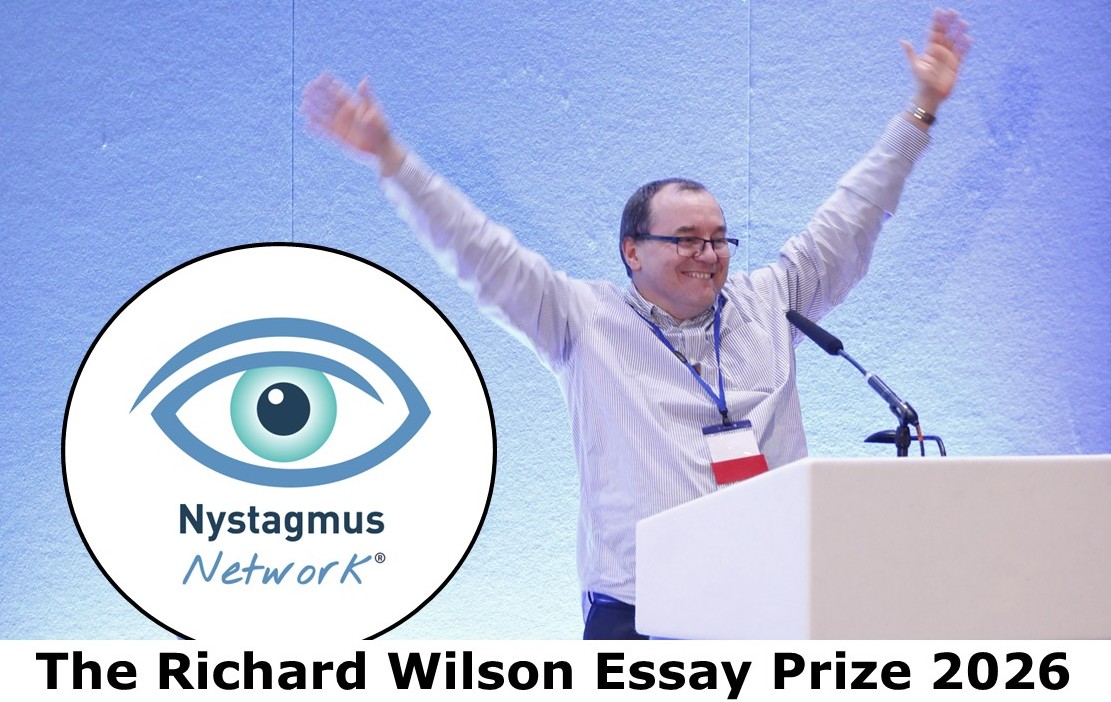
Richard Wilson, OBE
“How could AI change the way that nystagmus is diagnosed and treated?”

Judging criteria

For entries to be considered they must:

demonstrate a significant level of understanding of current clinical practice for nystagmus in the UK

pinpoint any key areas for development which AI could support

identify how AI assisted research can expand clinical knowledge of nystagmus

Format

Essays to be a maximum of 3000 words in length (excluding any diagrams, graphs, references, bibliography).

Timeline

Applications open in December 2025. The deadline for submission is 30 June 2026.

Submission

Completed essays should be emailed to research@nystagmusnet.org clearly marked ‘Richard Wilson Essay Prize’ in the subject line. Entries must include the full name of the candidate, the UK institution where they are registered, their current level of study and their highest academic qualification to date.

What is Nystagmus?

Nystagmus is a condition that affects the eyes, causing them to move involuntarily and repetitively. These movements can be side-to-side (horizontal), up and down (vertical), or in a circular pattern (rotary). 

The motion is usually rhythmic and can vary in speed and intensity. For people living with nystagmus, the constant eye movement can affect vision, depth perception, and balance, although the impact differs greatly from person to person.

There are two main categories of nystagmus: congenital (or infantile) and acquired. Congenital nystagmus typically develops within the first few months of life and is often linked to conditions affecting visual development, such as albinism, optic nerve hypoplasia, or congenital cataracts. In many cases, no single underlying cause is identified. 

Acquired nystagmus, on the other hand, develops later in life and may be associated with neurological conditions, inner ear disorders, head injury, stroke, multiple sclerosis, or the use of certain medications.

ww.nystagmusnetwork.org

Monday, 28 November 2011

British designed and manufactured lens corrects life-long sight problems and restores confidence for 59-year-old Jill Lang

HR advisor and corporate coach Jill Lang’s vision problems were so severe that she had relied on glasses, contact lenses and ultimately a combination of the two since early childhood. But as cataracts worsened her sight even further, Jill discovered a special kind of implant and eye surgery – designed by Queen’s Award for Industry award-winner, Rayner Intraocular Lenses - that would leave her glasses-free for the first time in 55 years.

The self-employed home-worker from Cirencester became one of a small number of patients to receive a made-to-order T-flex Toric intraocular lens (IOL) from the Sussex-based lens manufacturer this year. The operation has enabled her to see clearly without glasses for the first time since early childhood, restoring not only her sight but also her confidence: “I’ve gone from needing glasses to see things right in front of my eyes, to barely needing glasses at all.

“It is wonderful – being able to walk around the house and see everything clearly, and also being able to look out of the windows and see everything in the distance just with my eyes and no glasses or contact lenses. Losing your sight really ebbs away at your confidence – you start to question what may happen in the future. I’ve got rid of my cataracts and gained great vision at the same time.”

Jill, who has been extremely shortsighted her whole life struggled to see the blackboard when she was just four years old. After relying on glasses for day-to-day vision for over a decade, she received one of the first rigid multicurve contact lenses when she was 17 years old. The multicurve contact lens – a then revolutionary optical aid – had a special aspheric shape to minimise visual disturbances, while providing a convenient glasses-free method of seeing clearly. However after time, these hard lenses were damaging Jill’s eyes and she was moved onto soft gas permeable contact lenses, which worked for some time but 10-15 years later, they just weren’t strong enough.

At this point, Jill was prescribed a combination of contact lenses and glasses to correct her vision and enable her to go about her everyday life. “It was an expensive option, but it absolutely kept me going,” she explains. A couple of years ago, Jill developed cataracts, and was once again was plagued with severe vision problems.

This time, however, seeking treatment for her cataracts presented Jill with the unique opportunity of also correcting her lifelong shortsightedness and astigmatism with a tailor-made toric intraocular lens (IOL). The T-flex is an injectable lens developed specifically to correct astigmatism with high precision, at the same time as providing a clear replacement lens for individuals with cataracts.

Gloucestershire-based consultant eye surgeon Richard Caesar performed Jill’s operation. He said: “For most of our cataract patients we can use ready-made IOLs. Jill fell so far outside the standard IOL power range in both her degree of shortsightedness and astigmatism that she needed an incredibly special lens. She is one of the first patients in this county who has had a Toric IOL implanted for such extreme refractive error and we are delighted with her results.”

He added: “The Rayner IOL is incredibly well made and it is very stable. Once it’s in the eye it doesn’t rotate, which means that it gives you a very predictable result.”

Rayner Intraocular Lenses Chairman and Managing Director, Donald Munro said: “We pride ourselves in being able to design and provide premium-quality bespoke lenses for patients with intricate needs such as those experienced by Jill Lang. To be able to give clear sight and thereby change the life of individuals such as this through excellence in design and manufacture is a large part of what drives us.”

Indeed, Jill, who pre-operatively had very poor respective spherical and cylindrical refractions of -15.50 and -4.75 in her right eye, and -20.00 and -5.00 in her left eye, now has remarkably improved right eye spherical and cylindrical respective refractions of -1.75 and -1.00 in her right eye and -1.00 and -0.75 in her left eye.

Jill explains: "Not many people would underestimate the value of being able to see clearly. My cataracts are gone, and I no longer have to struggle with contact lenses and glasses - it really has been incredible. ”

For more information about Rayner lenses

(EDITOR: As a former cataract sufferer, I can agree that such implants make ALL the difference! And if you have a doctor who says you are too young to have the operation or that your cataract/s are not 'ripe' enough to be treated, then your doctor is 20/30 years behind the times and it might be worth considering changing your doctor.)