
In memory of Richard
Richard Wilson OBE served as Chair of Trustees of the Nystagmus Network from 2010 to 2019. During that time he introduced the very first Nystagmus Awareness Day, saw the charity’s investment in nystagmus research top £1,000 per week, established an annual UK nystagmus research workshop and hosted the charity’s first ever clinical training event.
Richard received his OBE from Her Majesty the Queen in the New Year’s Honours of 2018. He sadly passed away in 2023 and is fondly remembered by everyone.
Who can take part?
The competition is open to students of all levels, from undergraduate to post-doctorate, in the fields of Ophthalmology, Optometry, Orthoptics or a visual related science, currently studying or working at UK institutions.
Prizes
First prize: £500 and the opportunity to speak at the Nystagmus Network International Nystagmus Symposium 2026. Your cheque will be presented at a Nystagmus Network event.
Second Prize: £200
Third Prize: £100
Judges
The 2026 panel includes
Dr Onyeka Amiebenomo, Senior Lecturer in Optometry, University of the West of England Bristol
Mr Daniel Osborne, Research Orthoptist and NIHR Pre-Doctoral Fellow at University Hospital Southampton NHS FT
They will be supported in their decision making by Nystagmus Network trustees.
Essay Question for 2026
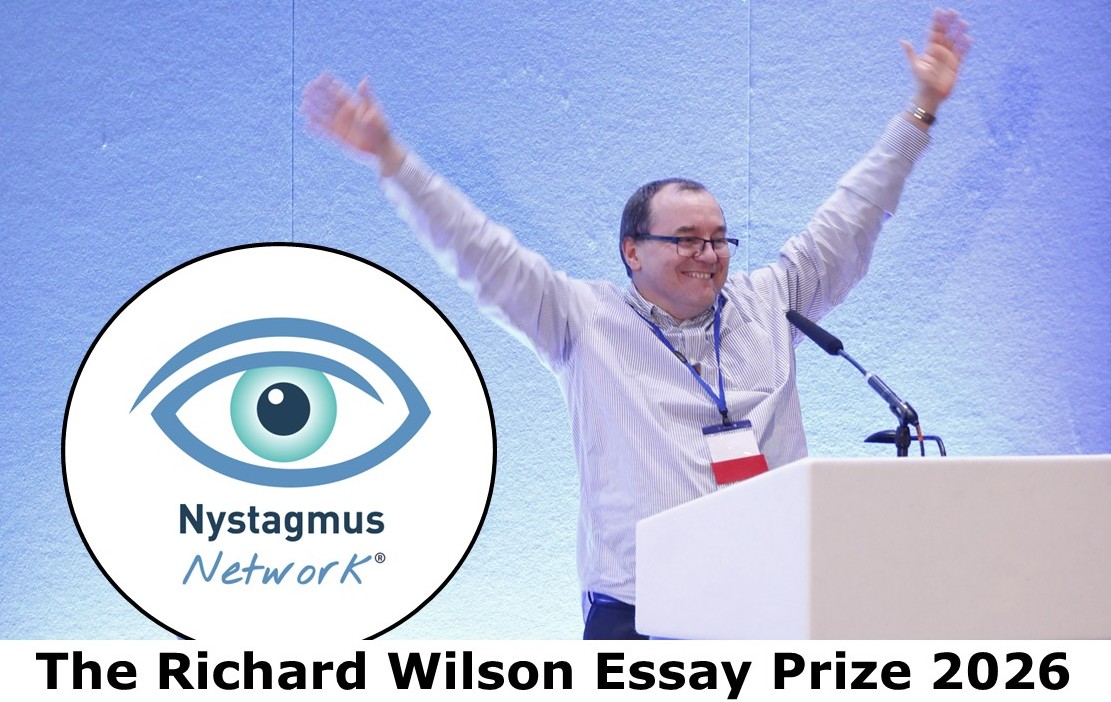 |
| Richard Wilson, OBE |
Judging criteria
For entries to be considered they must:
demonstrate a significant level of understanding of current clinical practice for nystagmus in the UK
pinpoint any key areas for development which AI could support
identify how AI assisted research can expand clinical knowledge of nystagmus
Format
Essays to be a maximum of 3000 words in length (excluding any diagrams, graphs, references, bibliography).
Timeline
Applications open in December 2025. The deadline for submission is 30 June 2026.
Submission
Completed essays should be emailed to research@nystagmusnet.org clearly marked ‘Richard Wilson Essay Prize’ in the subject line. Entries must include the full name of the candidate, the UK institution where they are registered, their current level of study and their highest academic qualification to date.
What is Nystagmus?
Nystagmus is a condition that affects the eyes, causing them to move involuntarily and repetitively. These movements can be side-to-side (horizontal), up and down (vertical), or in a circular pattern (rotary).
The motion is usually rhythmic and can vary in speed and intensity. For people living with nystagmus, the constant eye movement can affect vision, depth perception, and balance, although the impact differs greatly from person to person.
There are two main categories of nystagmus: congenital (or infantile) and acquired. Congenital nystagmus typically develops within the first few months of life and is often linked to conditions affecting visual development, such as albinism, optic nerve hypoplasia, or congenital cataracts. In many cases, no single underlying cause is identified.
Acquired nystagmus, on the other hand, develops later in life and may be associated with neurological conditions, inner ear disorders, head injury, stroke, multiple sclerosis, or the use of certain medications.

No comments:
Post a Comment